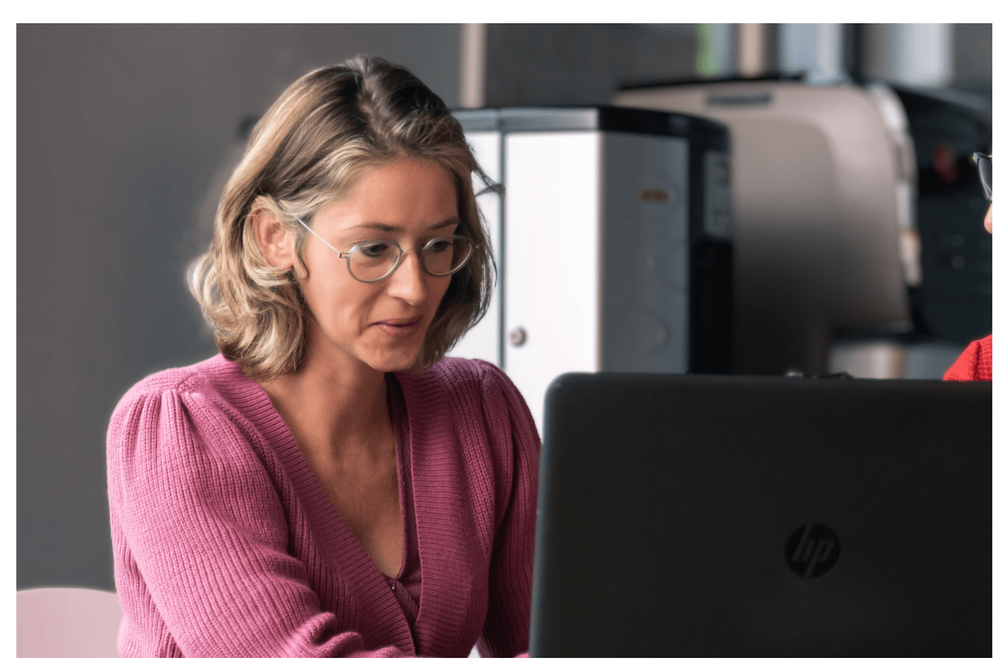
Our health might just be our most precious gift. Which is why accurate medical translations are of the utmost importance, as they can have a direct impact on someone’s well-being. Over the past few months, we have rolled out our ELAN AI Bridge and are fully embracing the newest technological feats. However, we remain convinced that AI works best when there is a human in the loop, and nowhere is this more important than in the medical field. We spoke with two of our internal medical proofreaders, Anja Thys (English proofreader) and Kim Hoebrechts (Dutch proofreader) about how they approach their medical translations.
Hello Kim and Anja. Glad you could find the time to answer some of our questions. Let’s start with an easy one. What fascinates you about medical translations?
Kim: I really like the fact that you always learn something new. The medical world is progressing all the time: new studies, new treatments, new insights. As a translator, you get the opportunity to be a part of that. This gives me a proper intellectual boost! (laughs)
Anja: For me as well, I have learned so much over the years. It is fascinating to see how it keeps evolving and what kind of illnesses and cures exist.
Why is a human expert still vital when it comes to medical translations?
Anja: For medical translations, it is indeed important that a human has control over the output. For example, there might be certain substances, concepts, or definitions that seem interchangeable or look alike but aren’t. When our well-being and lives depend on it, having a human doing the final check seems vital to me.
Kim: Precision is key in medical texts. Make no mistake, AI can be a valuable tool when translating or proofreading. It can provide suggestions, help with finding the right terminology, etc. However, medical texts are often complex, layered and depend heavily on context. You have to be able to understand the entire document, and sometimes even the wider clinical or scientific context, to fully understand it.
AI and machine translations can sometimes be inconsistent with regards to terminology. It might opt for a term that closely resembles the source word while being wrong. That’s why you need an expert to determine which term is the most appropriate. What is commonly used in this specific domain? Which terms will the target audience understand and expect?
Can you provide us with an example of an editing job in which you corrected a serious error?
Kim: I remember a translation in which “une étude avec souris” was translated to Dutch as “een study met mensen”(a study with people”). So it wrote “mensen” instead of “muizen”. It’s only one word, but the meaning changes drastically. These kinds of errors can occur with automated translation, but the consequences can be heavy in a medical context.
In a medical text, one wrong interpretation can change everything. That’s why you always have to remain focussed and on your toes. Is that the most accurate interpretation? Is it logical? You have to think analytically.
Anja: Oh, I have certainly found my fair share of serious errors in medical translations over the years. Most of the time, it concerns the use of particular words or misspelling that could lead to confusion. I do remember one translation in which the source text explained how to provide first aid, but in the target text the description would actually lead to suffocating the person requiring aid. That obviously needed correcting! (laughs)
One final question for both of you. What is the biggest challenge when proofreading a medical translation?
Anja: To me, it’s the terminology. Certain words look alike but they’re not the same at all. Another aspect that can be challenging are numbers, units, and data. This also involves checking that they were correctly and appropriately transferred from source to target. In the end, it’s all in the details and everything has to be 100% correct.
Kim: I think that the biggest challenge is fully grasping the content. Medical texts can be extremely detailed and pertaining to a specific field. They might contain terms that only mean something to specialists. Sometimes, I see texts in which multiple terms are used simultaneously, and they appear to be synonyms. For an expert, however, they are vastly different. As a medical translator or proofreader, you have to understand these differences.
Thank you so much for your time!
Are you also in need of medical translations? Curious as to how ELAN Languages combines the best of both worlds, the power of AI and human expertise, to deliver flawless and accurate medical translations? Contact Johan Noël via johannoel@elanlanguages.com or +32 11 43 47 64.