

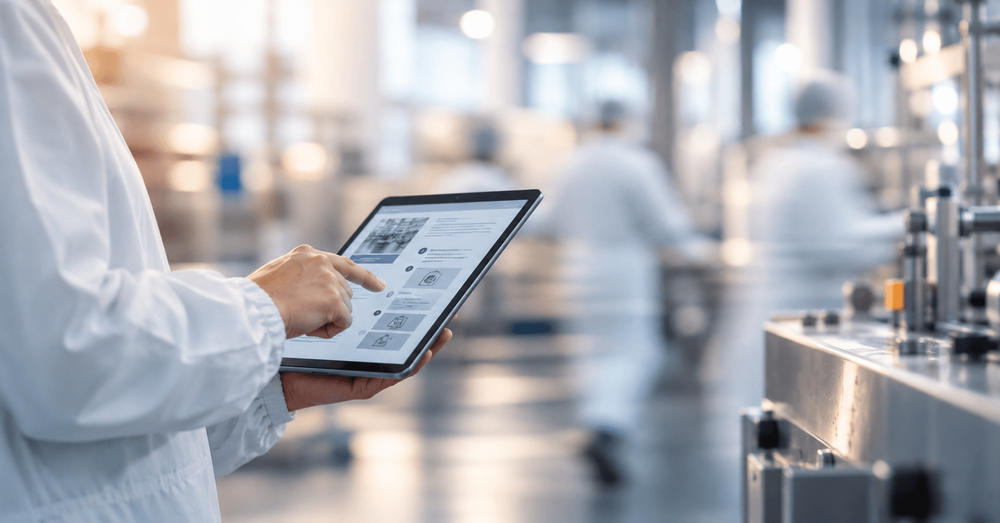
A food producer with six branches and documentation in four languages updates a cleaning procedure for its production line. One step changes, a contact time is clarified, and a warning is reworded. The new source version has been carefully reviewed and approved. This means that the various branches must also start working with the updated instructions. But the older translated PDFs remain in local folders, and not every branch has received the update.
How do you make sure that all language versions specify the same actions? That a critical technical term has the same meaning everywhere? And that employees use the approved update?
In the food industry, a translation must retain the same precision as the original.
An ambiguous instruction, a deviating unit of measurement or an outdated contact time can lead to a different procedure being followed. That is why multilingual production and cleaning documentation requires an approach that combines language, subject expertise and quality control.
From source change to use on the production floor
ELAN Languages works with the document controller, process owner and quality manager to examine the journey from source procedure to use at each branch. We examine critical passages, technical terminology and how translation, review and distribution are handled. We discuss unclear instructions with the person responsible for the content and involve local document controllers in distribution and replacement.
On that basis, we identify the improvements needed, focusing on three areas.
1. Agreed terminology as a foundation
Together with subject experts and local teams, we establish approved technical terms for each language and decide who will keep them up to date. This gives translators, reviewers, and employees the same reference for equipment, cleaning steps, and actions, regardless of the translation environment. It helps prevent recurring discussions about terminology when updates are made.
2. Technology and expertise tailored to the document
Together, we determine which approach matches the document and its risks: specialist human translation with revision, or AI-assisted translation with human review.
For AI-assisted translation, we use ELAN Libren, ELAN’s AI translation platform, to bring together business context, approved technical terminology, and quality checks. It provides translators and reviewers with a shared foundation for consistent language versions, and it can reduce manual transfers between systems via bespoke integrations.
A clear brief and specific review arrangements are always the basis. Language experts check meaning and wording; the authorised staff at the food company assess the technical content and approve the translation for release. For the cleaning procedure, the changed process step, contact time, and warning receive particular attention.
3. An update process that covers every language version
An update is only complete when the right language version is available to the employees who use it and the previous version has been withdrawn from use.
That is why we map out the entire follow-up process: which source changes trigger a translation update, which languages need updating and who is responsible for review, publication and replacement. A single point of contact, consolidated feedback, and a clear version overview show which areas still require attention. At each site, a designated person confirms that the new documents are available and old copies have been withdrawn from use.
We adapt this way of working to the existing document environment. If automation or integrations with ELAN Libren improve the handover, we include them in the setup. This ensures that every language version is tracked, from the initial change all the way to the actual use.
One coherent approach to multilingual documentation
Four accurate language versions. Six branches working with the right instructions.That is the goal. ELAN Languages connects every step: from clear source texts and agreed technical terminology to specialist translation, review, and publication. We turn our advice into practical working arrangements, the right language expertise and technology that supports the process.
We assess how well the approach works by looking at the time taken to approve translations, recurring corrections and outdated documents still found where they are used. Together, we build an approach that will hold up when the next procedure changes.
How do you ensure your procedures are accurate in every language?
ELAN Languages helps you identify where translation updates get stuck, what checks are needed, and how to ensure every branch uses the right version.
Contact Johan Noël at johannoel@elanlanguages.com or on +32 11 43 47 64.